-
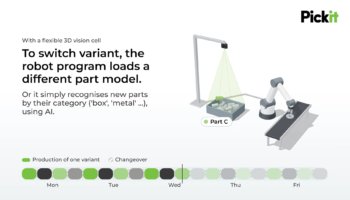
Too many variants to automate? How to handle high mix, low volume.
Traditional robot cells rely on fixed positions and predictable parts. Every new variant can mean new fixtures, reprogramming and costly changeovers. With 3D robot vision, you can handle more variants with minimal setup and great flexibility. AI-powered detection even allows you to recognise new parts by category, using a simple prompt like “box” or “metal” instead of configuring each variant individually.
Read more -
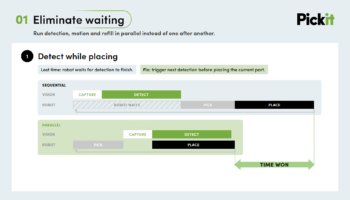
Where does your robot lose time?
Most of the lost seconds in a 3D vision-guided pick-and-place cycle come from waiting and unnecessary motion. We show how to fix this, with 8 practical tips you can apply to improve the cycle time of an existing cell.
Read more -
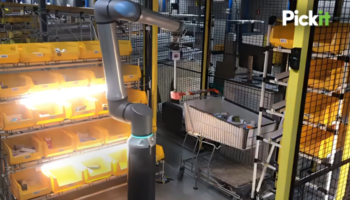
Teaching a vision system every new box? There’s another way.
In distribution, many different SKUs come through in boxes or pieces of different sizes, shapes and colors and changes happen often. For model-based 3D vision, that's a configuration challenge.📦
Read more -

Rigid Automation vs 3D Robot Vision: Which Pays Back Faster?
Two different types of automation: rigid and 3D robot vision. Similar investments. Very different return. Once the cells are running, both start earning back their cost. Then something changes: a new part, a new variant, a revised layout. For the rigid cell, each change means new costs in fixtures, reprogramming and downtime.
Read more
The cell with 3D robot vision handles the same change seamlessly as it can easily adapt. So it keeps moving toward payback. 📈 -
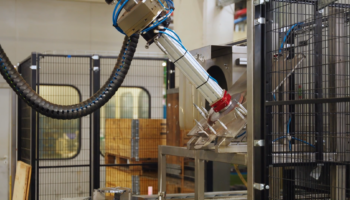
From manual handling to flexible automation at Picanol Group
Heavy gear handling. High product mix. Reflective metal parts. These were some of the challenges Picanol Group, an industrial manufacturing company, set out to solve through 3D robot automation.
Read more
Together with Proferro, Picanol Weaving Machines deployed Pickit 3D vision across three robotic workstations to automate the handling of heavy, reflective gear components. -

From manual loading to fully automated laser marking - powered by 3D robot vision.
When manual loading limits consistency and precision, automation becomes more than an upgrade.We contributed to a fully integrated Automated Laser Marking System, developed by GASBARRE, that combines precision, efficiency, and flexibility in one seamless workflow.
Read more -
 Read more
Preventing and recovering from collisions in Pickit 3D Applications
For automation engineers tackling their first 3D vision bin picking projects, nothing is more frustrating than a collision that brings the entire cell to a protective stop. The Pickit 3D system provides powerful tools to prevent these unwanted interruptions, and standard programming practices to recover quickly when the unexpected happens.
-

Streamlining battery pouch loading with 3D robot vision
Showcasing an advanced automated battery pouch loading process using an Autonomous Mobile Robot (AMR, MiR), Collaborative Robot (Cobot, UR), and a Pickit 3D vision system.
Read more -

Dual-arm robot picking random parts with 3D robot vision
Demo of an advanced dual-arm robotic solution picking random parts with 3D robot vision. This system is a game-changer for unstructured multi-object grasping, making automation more efficient in complex manufacturing and logistics environments.
Read more