-
 Weiterlesen
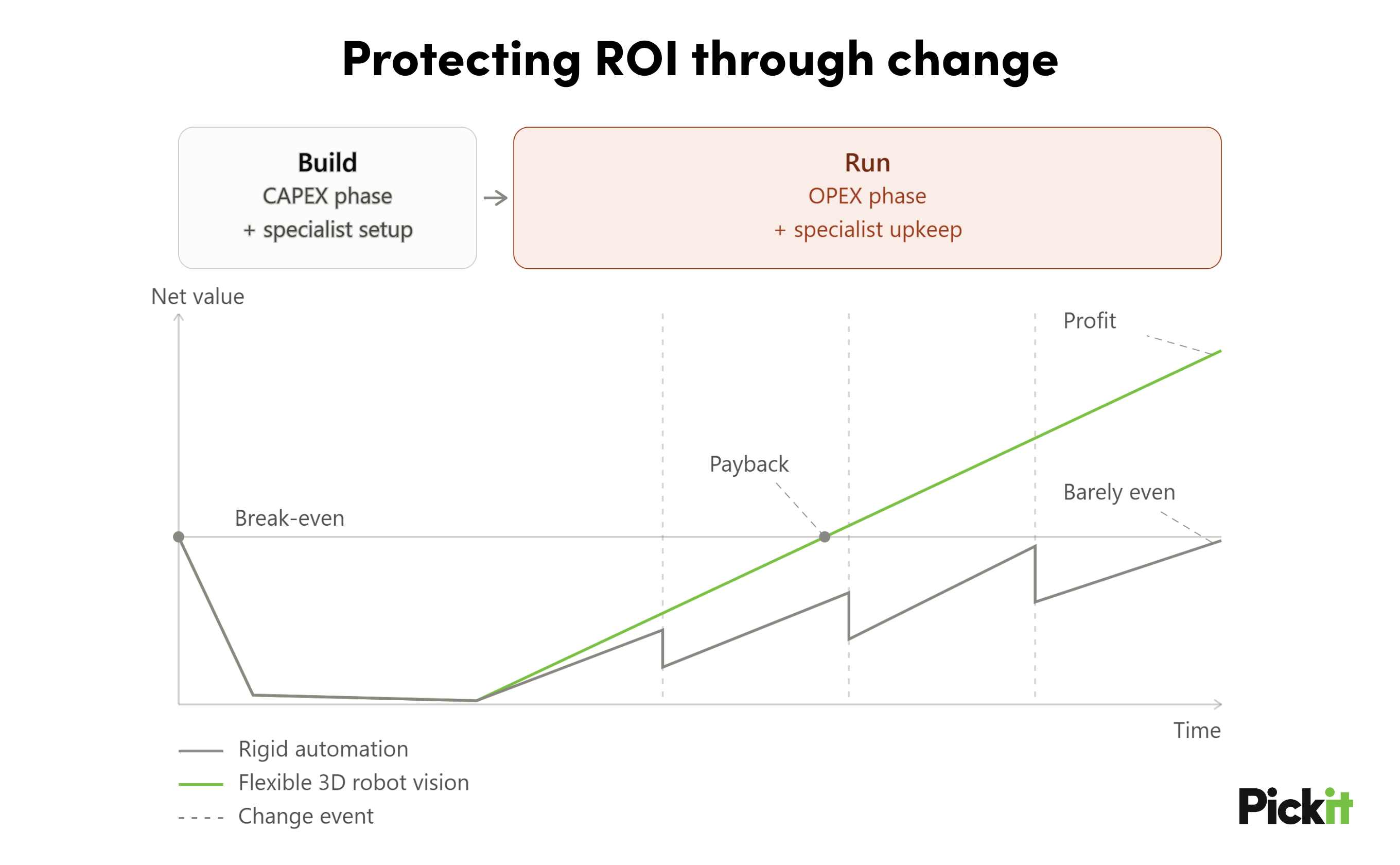
Automation's biggest cost is the cost of change
Your automation ROI isn’t won or lost on the first invoice. It’s often eroded by every change that follows. New part variants, revised layouts and changing process requirements can trigger extra engineering, new fixtures, revalidation and downtime. 3D robot vision helps cells adapt without rebuilding the process around every change, protecting the business case throughout the cell’s lifetime.
-
 Weiterlesen
Automotive on autopilot. 6 automotive cases powered by 3D Vision
Traditional automation depends on fixed positions, dedicated fixtures and predictable parts. 3D vision enables robots to locate components, compensate for deviations and perform complex production tasks even when picks or parts are different.
-
 Weiterlesen
How 3D Robot vision is transforming automotive quality control
3D robot vision is fundamentally changing automotive quality control from a reactive, downstream activity to a proactive, in-line process. Using laser-based 3D robot vision, manufacturers can deploy a 3D vision-powered in-line measurement system that performs real-time inspection of body parts and assemblies.
-

-
 Weiterlesen
The top 10 questions manufacturers ask
Thinking about using 3D robot vision in your operations, but not sure if it’s the right move? You’re not alone. Manufacturers come to us with very no-nonsense inquiries about feasibility, ROI, flexibility, integration, and impact on people and processes. So let’s tackle the 10 most common questions we hear, based on real conversations from the factory floor.
-
 Weiterlesen
Preventing and recovering from collisions in Pickit 3D Applications
For automation engineers tackling their first 3D vision bin picking projects, nothing is more frustrating than a collision that brings the entire cell to a protective stop. The Pickit 3D system provides powerful tools to prevent these unwanted interruptions, and standard programming practices to recover quickly when the unexpected happens.
-
 Weiterlesen
How to keep your robot from crashing into an iceberg
Collisions are like the icebergs of 3D vision bin picking. When using the Pickit 3D system, well-considered collision management helps you to detect, avoid, and recover from impact... preventing your process from sinking...
-
 Weiterlesen
How to set up a Pickit 3D robot vision application in minutes
Configuring a 3D vision system with Pickit is faster and easier than you might expect. The platform is designed to eliminate coding and programming, allowing you to set up a bin picking application in just a few minutes using only your mouse.
-
 Weiterlesen
5 ways 3D robot vision is transforming automotive manufacturing
By gives robots “eyes,” 3D robot vision is enabling smarter, more flexible automation that tackles today’s challenges, and is reshaping automotive manufacturing.