-
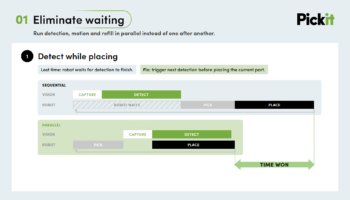
Where does your robot lose time?
Most of the lost seconds in a 3D vision-guided pick-and-place cycle come from waiting and unnecessary motion. We show how to fix this, with 8 practical tips you can apply to improve the cycle time of an existing cell.
더 읽어보기 -
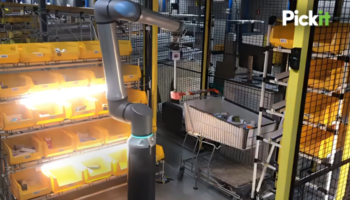
Teaching a vision system every new box? There’s another way.
In distribution, many different SKUs come through in boxes or pieces of different sizes, shapes and colors and changes happen often. For model-based 3D vision, that's a configuration challenge.📦
더 읽어보기 -

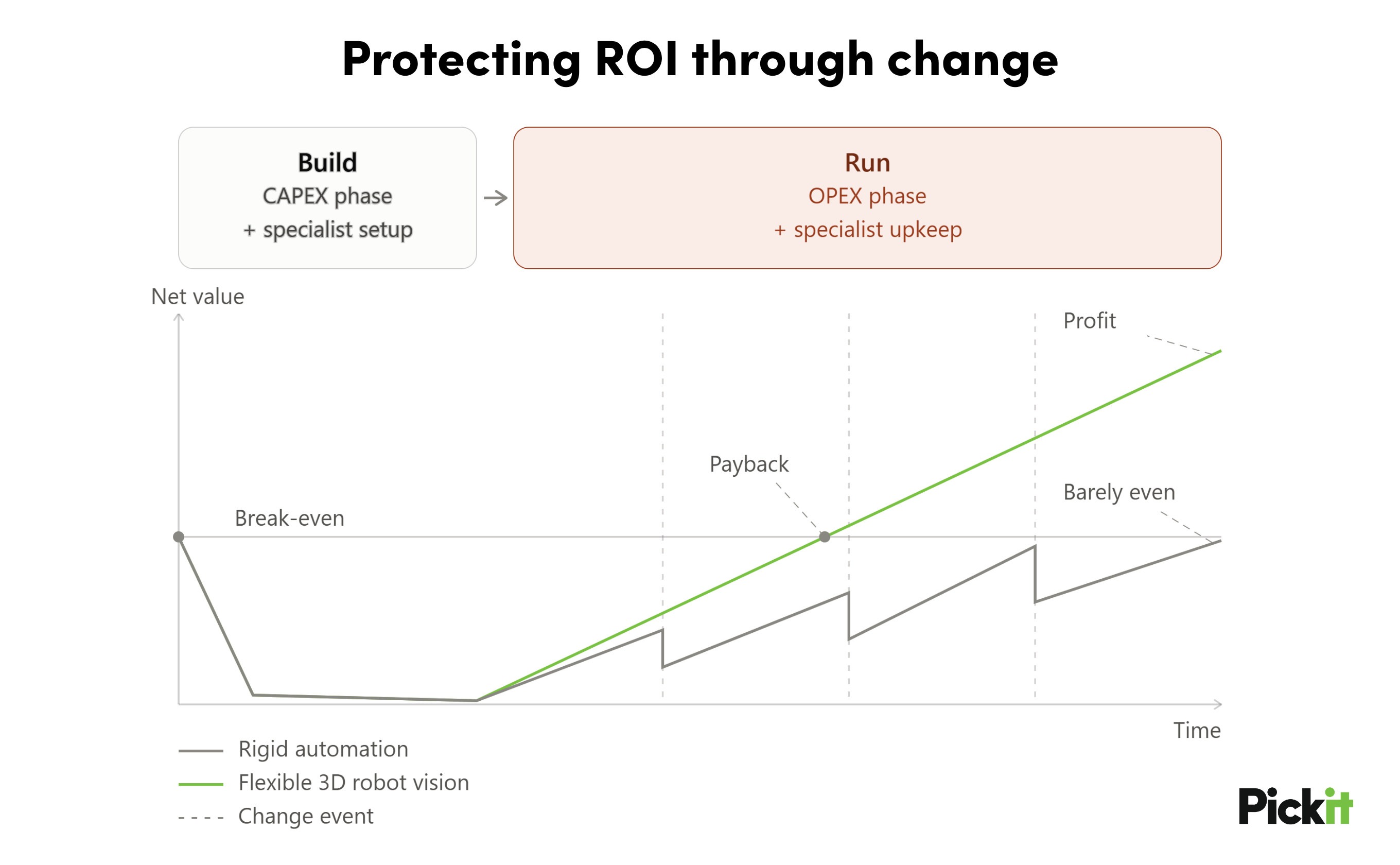
Rigid Automation vs 3D Robot Vision: Which Pays Back Faster?
Two different types of automation: rigid and 3D robot vision. Similar investments. Very different return. Once the cells are running, both start earning back their cost. Then something changes: a new part, a new variant, a revised layout. For the rigid cell, each change means new costs in fixtures, reprogramming and downtime.The cell with 3D robot vision handles the same change seamlessly as it can easily adapt. So it keeps moving toward payback. 📈
더 읽어보기 -
 더 읽어보기
Automation's biggest cost is the cost of change
Your automation ROI isn’t won or lost on the first invoice. It’s often eroded by every change that follows. New part variants, revised layouts and changing process requirements can trigger extra engineering, new fixtures, revalidation and downtime. 3D robot vision helps cells adapt without rebuilding the process around every change, protecting the business case throughout the cell’s lifetime.
-
 더 읽어보기
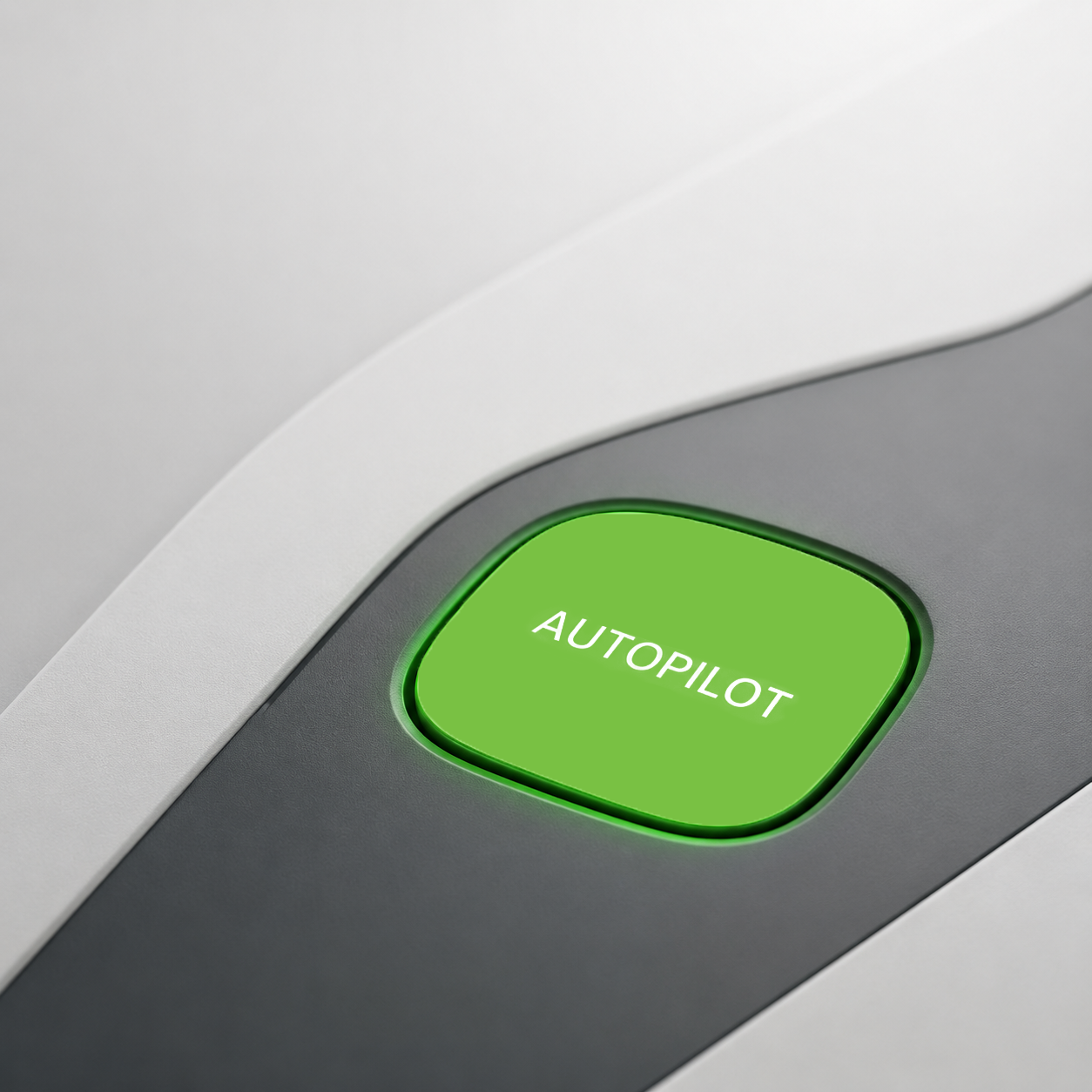
Automotive on autopilot. 6 automotive cases powered by 3D Vision
Traditional automation depends on fixed positions, dedicated fixtures and predictable parts. 3D vision enables robots to locate components, compensate for deviations and perform complex production tasks even when picks or parts are different.
-
 더 읽어보기
How 3D Robot vision is transforming automotive quality control
3D robot vision is fundamentally changing automotive quality control from a reactive, downstream activity to a proactive, in-line process. Using laser-based 3D robot vision, manufacturers can deploy a 3D vision-powered in-line measurement system that performs real-time inspection of body parts and assemblies.
-

-
 더 읽어보기
The top 10 questions manufacturers ask
Thinking about using 3D robot vision in your operations, but not sure if it’s the right move? You’re not alone. Manufacturers come to us with very no-nonsense inquiries about feasibility, ROI, flexibility, integration, and impact on people and processes. So let’s tackle the 10 most common questions we hear, based on real conversations from the factory floor.
-
 더 읽어보기
Preventing and recovering from collisions in Pickit 3D Applications
For automation engineers tackling their first 3D vision bin picking projects, nothing is more frustrating than a collision that brings the entire cell to a protective stop. The Pickit 3D system provides powerful tools to prevent these unwanted interruptions, and standard programming practices to recover quickly when the unexpected happens.