Pickit 4.1: Advancing 3D Robot Vision with AI foundation models
Configure your 3D vision in natural language using AI prompting for faster deployment and greater handling flexibility
While 3D robot vision is already a proven technology for handling variability in industrial automation, Pickit 4.1 just made it a lot smarter. Building on our 4.0 release, this update embeds training-free Foundation AI and Vision Language Models (VLM) directly into our platform, enabling it to understand scene context and conceptual categories like 'boxes' or 'plastic'. Pickit 4.1 allows users to enter simple natural language prompts to guide the system, instead of manual configuration. This makes deployments faster, simpler, and more reliable, while opening up new automation possibilities like mixed boxes bin picking and depalletization.
What's new in 4.1
Model-free detection with AI segmentation: This VLM-powered feature identifies entire categories of objects using simple text prompts, eliminating the need for geometric modeling or CAD files for every SKU. This enables an entire range of new applications handling a high-mix of SKUs with a single configuration.
AI Background Filter: This automated cleanup feature intelligently removes background clutter to isolate the objects of interest by leveraging prompt-based VLMs. This simplifies and accelerates deployment while delivering a substantial increase in detectability and reducing false positives.
Model-free detection with AI segmentation
Model-based detection requires a CAD file or a specifically "taught" model for every single SKU being processed. Managing 100 different boxes meant engineering and maintaining 100 separate configurations.
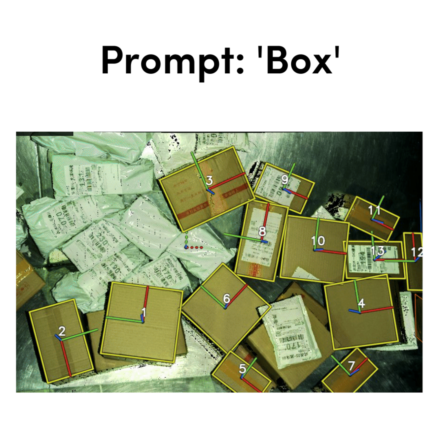
Pickit 4.1 introduces a highly anticipated AI segmentation feature that provides model-free detection. This VLM-powered engine identifies objects by category rather than by rigid geometry. Users can simply type concepts like "cardboard box" or "envelope," and the AI inherently understands the overarching category.
Key benefits:
Simplified configuration: This model-free approach yields important time savings for engineering teams. It requires only one single configuration for an entire category, even if that category encompasses dozens of different SKUs.
Handling variability: The system is perfectly suited for logistics and e-commerce environments. It easily handles "the unknown," accommodating operations where new packaging arrives daily without warning.
Accessibility: Configuring more extensive vision tasks just became even easier. It no longer requires vision expertise to configure the system; You can just configure it in plain English.
This model-free detection opens new horizons for flexible automation across various industries. Beyond standard mixed-box pallets and mixed bins, it unlocks 3D robot vision for pallets containing single boxes or single bags where there are many different SKUs to manage. Target applications include bin picking, parcel induction, container unloading, and complex depalletizing layers where every box is a different shape. This makes the 4.1 release an ideal fit for primary industries like logistics and pharma.
AI Background Filter: Automated scene cleanup for faster deployment
In traditional 3D vision set-ups, engineers define a detection area by drawing a 3D box (the so-called Region of Interest or ROI). If a deformed bin, a wooden pallet or plastic interlayer is detected in this predefined volume, production performance is impacted by missed picks, false detection and incomplete bin-empting.
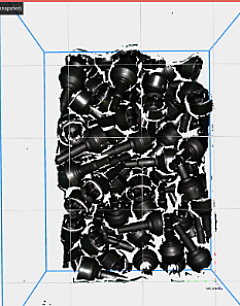
Pickit 4.1 resolves this limitation with the new AI Background Filter, an automated scene cleanup feature that utilizes prompt-based models to optimize and filter the detection area. By leveraging VLMs for intelligent scene segmentation, the filter automatically removes interlayers, plastic foil, and pallets from the point cloud. Instead of relying on geometric boundaries, users can now instruct the system with prompts like ignore “wooden pallet" or only show “plastic bottles".

Key benefits:
Deployment efficiency: This prompt-based segmentation drastically simplifies the deployment process. It significantly reduces the engineering time traditionally spent on optimizing the scene.
Improved reliability: By effectively removing unnecessary information created by interlayers and plastic foils, the system achieves a substantial higher detectability rate. The system can now successfully see parts it previously missed and eventually empty the bin more.
Reduced errors: The filter significantly reduces false positives. It prevents the robot from mistakenly trying to grab the floor or divider sheets.
Operationally, these improvements deliver higher bin-emptying rates and require fewer manual interventions on the factory floor. The filter is particularly valuable for bin picking where plastic foil or liners interfere with the parts of interest.
3D robot vision just got a lot smarter
Pickit 4.1 makes 3D robot vision significantly smarter by bridging the gap between advanced Foundation AI and practical industrial application. By transitioning from rigid configurations to flexible, prompt-based understanding, this release empowers automation engineers to deploy robust systems faster and more reliably. Whether working in unstructured scenes or automating highly variable parcel picking, Pickit 4.1 provides a reliable, model-free path to scale automation seamlessly.